
In Conversation: Caren Wenqing Ye on Building Spaces for Connection, Experimentation, and Presence

Caren Wenqing Ye is an interdisciplinary artist, designer, and producer based in Brooklyn, New York. Her practice moves between ink and algorithm, virtual reality and light to craft experiences that encourage introspection and empathy. Through illustrations, animations, performances, and immersive spaces, her work flows across mediums, unrestricted by tools and rooted in vision—turning the creative process into a shared space for playing, healing, and growth for both the creator and the witness.
Q: For readers new to your work, how would you introduce your practice as a whole: what core questions tie together your art, design, performance, community organization, and curation across your projects?
When I studied architectural design in undergrad, there was always this classical question of form and function. People often tried to answer one or the other, but I always felt there was a natural harmony and balance between the two, inseparable from each other like body and mind. This understanding carries into my multimedia art and design practice as well.
We have so many tools and mediums to present ideas and stories, but the choice of medium is always integrated with the central thesis, emotions, and narratives. That is why my work spans across diverse mediums, and why I believe art is accessible in daily life, not only in museums but also in fleeting moments, like listening to a song on the bus or watching nature pass by.
I do not really see boundaries between art, design, performance, and curation. Performance, for example, builds on liveness, a shared presence with the audience. Communication itself can be a kind of art, almost like a real-life theater. I once questioned whether I should position myself more as a “creator” (artist or designer) or as a “connector” (curator, producer, or community organizer), but eventually realized I do not need to draw a sharp line.
I feel grateful that most projects I have been involved in, whether in art or design, have felt like destined encounters. In Chinese, we call this 缘分 (yuanfen), a word that suggests karma but with a romantic tone. Each project, from The Gates Augmented Reality Experience to my research residency at NYU ITP, my current fellowship at Theater Mitu, and other design commissions, has been connected through this sense of resonance.
Q: In “Breathing Prairie,” you translate breath into image and sound in real time. What did working with biofeedback teach you about turning inner states into shared experience, and which of those lessons carried forward into your later pieces?
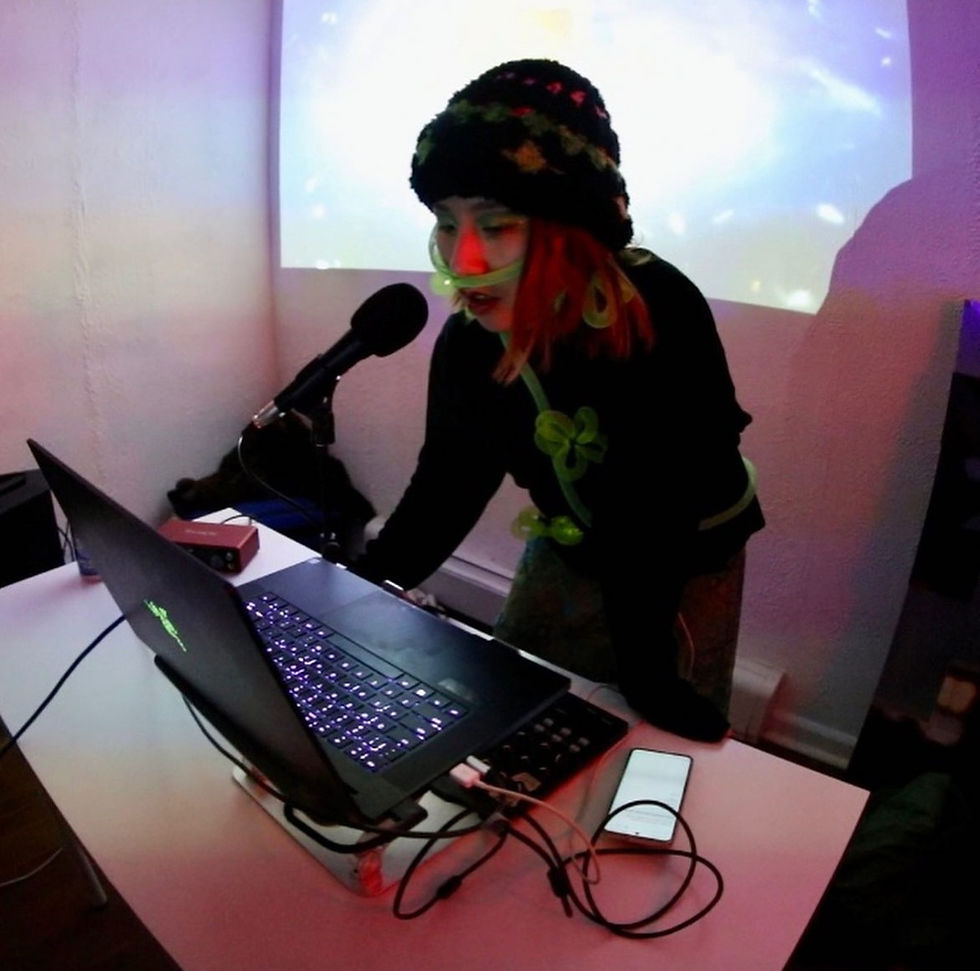
Turning breathing into an instrument was fascinating for me because for a long time I had been thinking about how to bring liveness, a true sense of presence, into art and performance. It felt natural to begin by experimenting with breath as biodata.


I explored several ways to connect breathing data, such as using an Arduino pressure sensor, a phone’s tilt to transmit OSC communication, and a webcam. I was fortunate to have my friend Pedro Sodore assist with the technical process. Over time, I realized that the real challenge was not only technical but also about interface design. How could breathing feel like a natural interface?
With the pressure sensor, we designed a wearable belt that detected belly movement. The webcam approach required standing completely still, otherwise it would not register. Using the phone for OSC communication felt even more awkward because you had to place the phone directly on your stomach.

I learned that biodata is not just about technology but about creating an interface that feels intuitive and embodied. For Breathing Prairie, the wearable belt made the sensing process more natural, and it turned out to be remarkably sensitive.
When I performed with it for the first time at The 370 Jay Garage Space, and later at :iidrr Gallery in New York, it felt unexpectedly vulnerable to expose every inhale and exhale to the audience in real time. My entire being was on display, and that vulnerability created an intense sense of presence. At the same time, the breath was transformed into an audiovisual experience that felt both intimate and expansive. It was a deeply moving process, and it is definitely a piece I plan to keep developing.

Q: In “Rhizome,” TouchDesigner and a Stable Diffusion pipeline respond to movement and sound. How do you choreograph agency among the dancer, sound, AI and the audience?
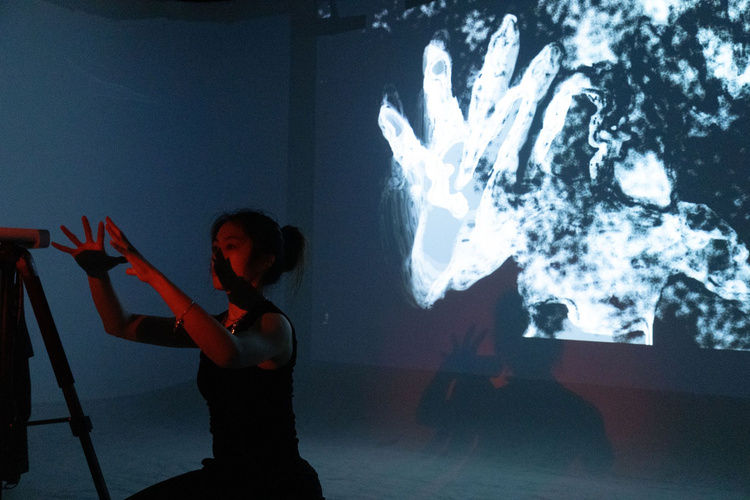
Rhizome was a meaningful example of how an emerging medium can align with a theme that deeply intrigues me. During Jukebox of Dissonance: The UAAD Festival in 2024, real-time AI tools like the Stream Diffusion plugin for TouchDesigner had just begun to appear. I immediately felt that the medium was perfectly suited to an idea I had wanted to realize for a long time.
In nature, I often notice endless similarities and repeating patterns: fractal structures that appear in tree trunks, blood vessels, neural pathways, galaxies, landscapes, and even subway systems. These patterns recur everywhere, from the spirals of a sunflower to lightning, snowflakes, marbled beef, and the textures of skin.
AI made it possible to bring this vision to life. We were surprised by how smoothly it worked, even though the technology was still quite new. That became our starting point. Together with my collaborator Shiqing Chen, we developed both the narrative and the performance system in TouchDesigner. We were also fortunate to work with dancer and media artist Audrey Chou, whose movement translated the awe of these natural correspondences, the intimacy between human and nature, echoing the ancient Chinese concept of Tian Ren He Yi (天人合一), the unity of humanity and the cosmos.
We collaborated with musician Milam for the sound, a longtime collaborator and college friend. His sonic practice has always carried a spiritual dimension, exploring themes of nature, art, ancient Chinese philosophy, and concepts such as cyber Buddhism.
One of the most magical discoveries came from the audience itself. At one point, when people stood in a line in front of the Kinect camera, the AI transformed them into a row of trees whose roots were interconnected. That visualization was incredibly moving and perfectly captured the essence of what we hoped to express.


Q: At MOONSTOP’s Spring/Summer 2025 launch, you translated your audiovisual language into a fashion context. What shifted - audience attention, pacing, color vocabulary, or narrative arc? How did your ongoing collaboration with Milam inform the atmosphere you wanted to build that night?
For MOONSTOP’s Spring/Summer 2025 launch, it was not a runway in the traditional sense but a “Lounge” we hosted at Tea at Shiloh, a tearoom and art space in Los Angeles. The choice of venue already revealed the essence of the event. Rather than focusing on the spectacle of clothing on a runway, it centered on community and on the lifestyle and philosophy that MOONSTOP represents: a way of living rooted in harmony and gathering, drawn from an ancient Chinese sensibility of shared presence.
The event reflected that ethos. It was not only about fashion but also about crafts and community rituals. There were handmade bracelets, incense coins, painted totes, and shaded corners where people could sit and connect. Our audiovisual performance was woven naturally into this ecosystem rather than standing apart from it. I was even surprised to see that the clothes almost faded into the background while the atmosphere of shared creativity and presence came to the forefront.
Visually, I created work using the Stream Diffusion plugin in TouchDesigner, again in collaboration with Milam. The season’s theme was “Tree,” so I built imagery that moved through different expressions of trees, from cosmic and otherworldly forms to abstract textures inspired by bark. Milam’s soundscapes extended this further, setting an emotional tone that blurred the line between an art performance and a lifestyle gathering. In that sense, the evening echoed the same rhythm as my art practice. It was about creating a space where people could feel connected, inspired, and part of something larger than themselves.

Q: During the Mitu fellowship, what questions are you pursuing at the intersection of performance and technology? How are you prototyping them toward upcoming showings (perhaps site-responsive works like the Othership sauna performance) and what kinds of sensors, bodies, or environments are you testing next?
During the Theater Mitu Hybrid Arts Lab fellowship, I have been deeply interested in how art and spiritual practice can come together. In my daily routine, I do visualization exercises on impermanence, the rarity of the precious human body, and the nature of emptiness. One of my recurring themes is joy as a resource and inspiration for awakening—finding truth through joy. I find this especially fascinating because many of the art forms I love, whether jazz or hip-hop, carry that transcendent quality. They remind me that everything—suffering, happiness, the rises and falls of life—is both illusory and tangible at the same time.
In everyday life I experience all kinds of highs and lows, and living in New York I feel fortunate to encounter powerful performances that often serve as light and salvation in difficult times. I feel deeply grateful for art and believe it can serve as a language for awakening.
Performance feels like the most direct way to explore these ideas. It brings something into the present moment, creating an energy field where presence and flow can emerge. That is why I see performance as central to my work. It can shift everyday spaces into living rituals.
For example, this past summer at Theater Mitu I developed TangTangTangTang: Performative Ritual in Flow at Othership Williamsburg with artists Lu Zhang and Jiaoyang Li, hosted by Chinatown Basketball Club and Culture of Bathing. The venue, a sauna and ice bath house, became a stage for a collective ritual. I led breathing meditation, guided participants into the ice bath, and created a media wall with Tang dynasty–inspired imagery and visualizations of qi that guided people through Tai Chi movements. It was both a personal challenge and a shared ceremony, using technology and performance to transform the bathhouse into a field of communal energy.
TangTangTangTang: Performative Ritual in Flow, Othership Williamsburg, New York. Video still by Alexarcher Lawson
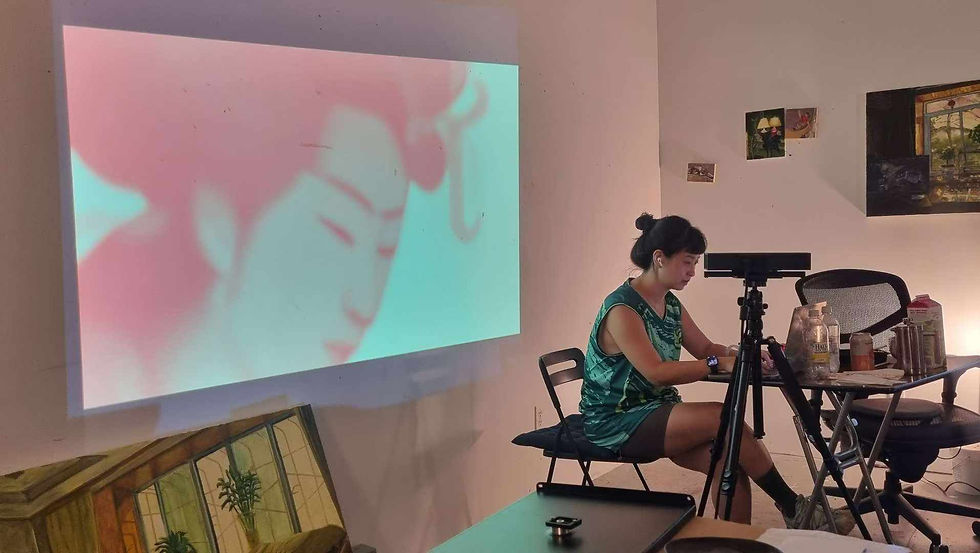
At the same time, I have been exploring embodiment through acting, something entirely new for me. Recording myself speaking to the camera and performing expressions led to unexpected self-discoveries. I realized that acting does not have to mean pretending. Instead, it can be a way to explore different aspects of myself and uncover hidden potential. The goal is not to perform artificially but to move toward what feels authentic and natural, even if it begins with deliberate experimentation.
I am now developing an online performance persona as part of my prototypes for Mitu’s open studio in late November. This connects back to a project I started three years ago on the Chinese platform Douyin (TikTok), where my friend Ray and I created mindfulness content and witnessed how online presence could foster genuine connection. I see social media platforms like Instagram and Red Note as contemporary playgrounds for performance art. Just as we brought performance into a bathhouse, we can also bring it into the digital spaces we inhabit daily.
For me, this is about exploring authenticity, awareness, and the many potentials we all carry. It is about embracing the media forms of our time while asking how we can engage with them more consciously. Ultimately, this hybrid approach—between online and offline, staged and everyday—has become a way to explore and deepen both my life and art practice.

Q: Between organizing “connect→collide→collab” and your earlier institutional work on “Asia Digital Art Exhibition,” you’ve moved from showcasing finished pieces to holding space for the messy middle. How did facilitating community engagement change your concepts on curation & event organization, and what do you hope a sustainable ecosystem for art practitioners looks like in the next few years?
For me, the Asia Digital Art Exhibition a few years ago was more of a training ground for my capacity as a producer, executive assistant curator, and coordinator. It embodied what I call art as communication—a different kind of art in itself. I had the chance to work closely with some of the most outstanding digital artists in the world, like Ho Tzu Nyen’s team, Ryoichi Kurokawa, and Refik Anadol. Putting together such a large-scale international exhibition was spectacular in its own right, but it was also a socially engaged work. Beyond the artworks themselves, it meant handling everything from logistics and contracts to flights and visas, collaborating with construction and operations teams, and bringing together many different parties within a very short timeframe. It was incredibly challenging.


By contrast, when I co-founded NIME Club Shanghai (New Interface for Musical Expression), it was almost the opposite experience. Instead of strict deadlines and multiple institutions, we had to build our own structure from the ground up. We did not want it to be too loose, but also not so pressured that it lost joy. We adapted the NYU ITP NIME class syllabus and referenced material from past NIME conferences. Over five months, we met nearly every week for workshops, artist shares, prototyping, making, and feedback. In the end, we organized a performance showcase at Xinchejian in Shanghai that drew more than 300 people. That same year, three of our works were selected for the official NIME Conference at NYU Shanghai 2020. It was incredibly rewarding to see how a self-organized community could generate such meaningful impact.
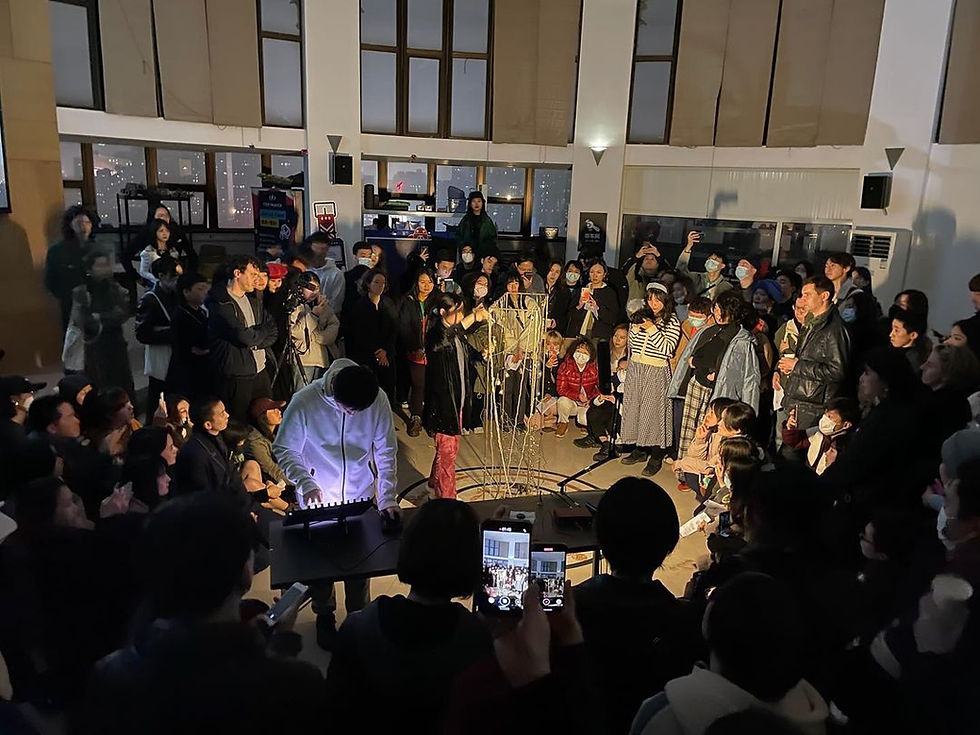
More recently, with connect→collide→collab hosted with UAAD, I have been interested in holding space not only for finished works but also for the messy middle—the early collaborations, the experiments, the collisions that happen before a piece becomes polished. These experiences have deeply influenced how I think about curation and event organization: less about the final product, more about building ecosystems for experimentation and exchange.


As for what a sustainable ecosystem for art practitioners might look like in the coming years, I think it must balance both the wide reach of online, surface-level connections and the depth of long-lasting ones. Social media is often criticized, but I see it as a neutral tool. The question is how we use it. The challenge lies in making it healthier, both mentally and physically, and seeing it as a mirror of ourselves. Why do we scroll endlessly? Is it from emptiness, a hunger for information, or unconscious habit? These platforms can help us see ourselves more clearly if we pay attention.
At the same time, this era often makes people feel that social media visibility is a requirement. For some, that feels natural; for others, whose personalities do not lean toward constant sharing or self-exposure, it can feel forced. I think that is completely valid. What matters is finding your own rhythm of expression rather than following a single model of how visibility should look.
With the rise of AI tools like Sora2, questions of authenticity and online presence are becoming even more complex. Some people worry about AI, algorithms, and automation taking over, but to me that only highlights the importance of strengthening what is truly human. Otherwise, we risk being pulled off course. You can play the game of money and fame, and perhaps succeed, but those things are fleeting and often create new forms of suffering. In the end, there is a Chinese saying, “冷暖自知,” which means “the warmth or the chill is known only to oneself.” What truly endures is peace and openness of heart, the flow of kindness, and the kind of genuine connection that reflects our shared humanity.
Q: As you look ahead, what kinds of collaborations or projects are you most excited to work on next?
Right now, I am centering my energy on Theater Mitu, preparing for the studio weeks and the open studio in November. I have been developing the idea of online performance, using social media platforms as both an artistic and performative space, and experimenting with AI for visual storytelling. I was inspired by my artist friend Carrie Sijia Wang, who developed Whose AI to explore her complex feelings about artificial intelligence by engaging with it directly and testing it with different communities, including schools. For me, it is a similar process. You have to experience it firsthand in order to understand what it truly feels like. It is also a way for me to raise my own awareness as an artist, to observe myself and society through the process.
Recently, I had been wishing for a chance to work on AI-based visual storytelling, and then it appeared almost serendipitously. A film director reached out to collaborate on an art short film demo. Our original plan involved 3D modeling and animation, but the timeline was too short, so I suggested using AI instead. The style we envisioned was a kind of sci-fi archaeology, something that would have been too complex to shoot in real life. Much of it came from imagination, and AI surprised us by capturing exactly the kind of otherworldly, imagined atmosphere the director had envisioned. That experience was deeply striking for me.
At the same time, I do not want to chase trends or rely on hype. What matters to me is staying grounded in what it means to be an artist—maintaining awareness and authenticity. The most exciting part of this journey is collaboration, not only with other artists but with people from different disciplines and ways of thinking. I am curious about the unexpected connections that can spark when diverse minds come together.


Comments